Thanks, Gina and Darlene, for the resource recommendation!Darlene Hays sent me an email this morning about a math and science website that I tried to access for our lab last year, but couldn’t because the videos were YouTube. I wrote to professor Khan and asked him if he would consider creating a mirror site that districts could allow. He never replied, but his site is now accessible! And it is extensive!www.khanacademy.orgWhat I especially love about this site is that Professor Khan breaks concepts down into very simple forms. Students then have access to another teacher to learn from, as well as, offering teachers a way to brush up on a particular concept or area of math/science to help you teach it.The videos are clean, no buffering issues that I’ve detected so far. In one year he has managed to really expand and develop the site. You will be amazed! :)I have 3 students using the site in the lab right now and they are fully engaged.Enjoy.
Thursday, February 17, 2011
Guest Post: Khan Academy Online Math & Science Resource
Hello! This week I've got a guest post from a friend and colleague at Minneapolis Public Schools ABE, Gina Jarvi. She writes:


Thursday, February 10, 2011
Tuesday, January 4, 2011
20 Things I Learned About Browsers and the Web
Have you ever wondered "What exactly is a 'URL' anyway? Or an IP address? Are they the same thing?"
Or maybe you recently found out your computer has been compromised by Malware (malicious software) and you want to know more about how to protect yourself.
Or your anti-virus software keeps warning you about "tracking cookies / low threat" and you're wondering what that means, exactly.
Or you're just curious about technology and the web and would like to understand how it works.
If this sounds like you, then you should read this e-book from Google! http://www.20thingsilearned.com/
If you read it, feel free to leave a comment here with a "Thing you learned" and if you found it helpful.
Wednesday, October 6, 2010
Learn English Words - Cab
Watch and Understand: The power of video for teaching vocabulary.
And for the geeky science buffs out there: remember that rich experiences (those that engage several senses) are more deeply encoded the brain.
We often use simple images to teach words like "cab," of course. But I'm betting that this video presentation will get the job done faster and better (e.g. better retention later on) because it is so visually and auditorially rich.
Chalk up one more reason why schools need to get with 21st century and stop blocking YouTube - especially for adult learners.
Tuesday, October 5, 2010
Writing by Hand is Good for you - and your Learners!
 |
| Creative Commons licensed photo from Flickr |
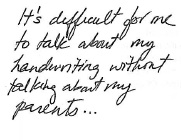
Check out this article from the Wall Street Journal about How Handwriting Trains the Brain.
Some interesting points:
- writing characters by hand improves retention of new information when learning a new script or becoming literate for the first time. Teachers of non-literate adults: make sure they are practicing writing their letters, not just reading them!
- writing text out long-hand may help keep your brain "sharp" as you age - it's "cognitive exercise"!
- children wrote more (more words, more ideas) in assignments done by hand than at the keyboard, indicating that the act of putting pencil to paper may improve writing output for learners.
- applications are coming out for touch-screen devices (smart phones, iPad) that allow you to input text by drawing the characters on screen with your finger or a stylus. Could adult learners use something like this to learn the alphabet? Anybody out there have a iPad to try it on?
And thanks to Larry Ferlazzo for sharing this on his website of the day blog and tipping me off to it.
 |
| Creative Commons licensed photo by Dan4th on Flickr |
Tuesday, August 17, 2010
See you at Summer Institute!
The annual MN ABE Summer Institute is nearly here! Will YOU be there?
Since I'm both a) on the planning committee and b) leading 3 workshops and one discussion session, you'll probably see me around!
At MLC the Technology Services Department has an exciting new program rolling out this fall, one I'll be heavily involved with... but hush! It's a secret till tomorrow. Summer Institute is our venue for telling all. Hope you'll be there to get the scoop. If not, keep an eye on this blog for an update soon!
Friday, July 9, 2010
Computer Terminology - What Words Cause Confusion?

My hope is to orient participants enough (and reduce anxiety enough) that they can begin trying to teach themselves new computer skills. I'm focusing on a few fundamental Windows tasks (like using the taskbar and right-clicking for contextualized menus), Internet and browser basics, and perhaps most importantly, clarifying vocabulary so that teachers can more fully participate in the technology conversations going on around them. To this end, I'm coming up with a list of specialized computer terminology that has become ubiquitous, but often needs explaining to people who are not comfortable with computers. Words like "upload" and "download" are on there. "Browser" and "URL" and "Wi-Fi" are too.
But my question for you, dear readers, is: What words do you think cause the most confusion? Is it functional stuff like I've listed above? Or is it names of products/services like Twitter and YouTube that cause anxiety among the uninitiated? If you were a rank novice in the land of computers, what terms would you most want defined and clarified so that you could begin teaching yourself?
Send me your thoughts in a comment, or look me up on Twitter or email. I'm not hard to find.
Subscribe to:
Posts (Atom)



 Posts


